Thursday, September 23, 2010

Cheese, less glorious cheese

So remember way back when I left a promissory note in the blog that I would write a whole series of cheese posts? Much to the relief of some of you I'm sure, I never got around to it (though I did take pictures of many of those cheeses so you never know!). And if that was you, well you can rest assured that you will not be getting any documentation about the cheeses that are readily available in the average supermarket here.

Well, you won't after this post.

Note to cheese entrepreneurs: don't choose a name for your dairy product that makes it sound like animal parts in gelatin. When I'm in the mood for cheese, I'm very definitely not in the mood for head cheese.


Or there's this one, which at least sounds economical and dietetic, though not necessarily good:


Sigh.

Actually, there is good cheese here. It's just that what was "everyday cheese" in France seems to be a luxury item here. So perhaps for our next special occasion dinner, I will visit the specialty grocer with a walk-in environmentally controlled cheese room! Until then, Laughing Cow and Babybel are as good as it gets ... at least those names are slightly better than the ones here?

Monday, September 13, 2010

And the winner is ... bags!

Well, maybe not the winner. I actually still don't know which take-away container is the most common. However, the bag is indeed proving very popular for cold drinks. I see it all over the place, and have now been given a few myself.

Sugar cane juice with lemon:

Note the straw sticking out of the bag. The vendor put the half lemon in the bag, tightened the bag and squeezed it (oh the convenience!) then added ice, (freshly pressed) sugar cane juice and a straw. (I should add that this was possibly the best sugar cane juice with lemon that I've had here.)

Also used for iced milk tea:

Someone in front of us in the milk-tea line bought tea for four -- and it is definitely easier to carry four of these one handed than four cups (maybe even when those four cups are in a carrier). The coldness of the ice also circulates better in the bag than in a cup.

And here's how you drink out of the bag:

While walking.

Although you can't really see it in this photo (yes, the camera does take videos ... if its user switches from camera to video mode), James is in motion -- a key element to the bag take-away format because the fact of the matter is, you're not going to be able to set the bag down on your desk (oh the inconvenience!).

You could, of course, pour your beverage into another vessel (like we did the Indian food). James suggested that one could instead hang the bag from a coat rack or doorknob in your office. Now if I could just find a 10-foot straw ...

Tuesday, September 7, 2010

Monday, August 30, 2010

Bag of coffee, anyone?

The other day I saw a man walking down the street, carrying what I could have sworn was a bag of coffee.

At the time, I thought maybe his coffee cup had sprung a leak and he just let all the coffee leak into the bag and got rid of the cup.

Ok, that probably sounds really odd and you're thinking, "What planet did you grow up on and why in the world would you think that?". To which I respond with this photo:


It seems that the drink carrier given out by most business here in Singapore bears little resemblance to its American counterpart in cardboard or molded paper pulp, as the case may be.

In fact, my first thought when I saw the guy with the coffee bag was that he was lucky he didn't get a carrier like this one. This other local version is basically a plastic coffee sleeve, with a strappy handle, but with no reservoir for coffee to leak into. (This photo isn't ideal, but this guy was sort of onto me so it was the best I could get.)


And then we got some carryout Indian food for dinner.

The tandoori chicken and the naan came in styrofoam clam shells and the pratha came wrapped in paper. Everything else -- the rice, the chutney, the dal, the aloo gobhi, etc. -- in bags.


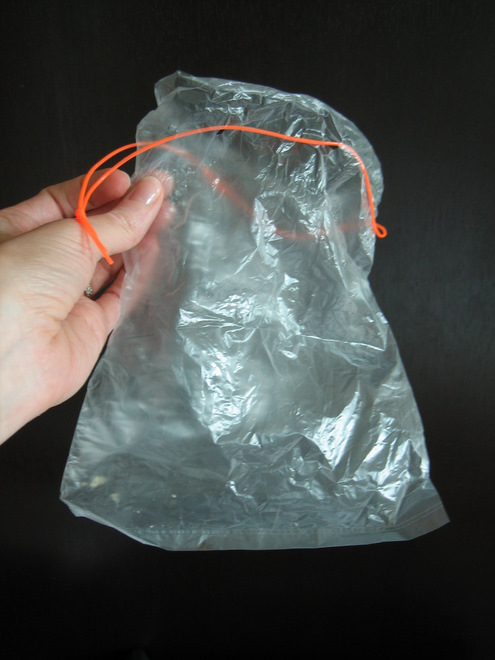
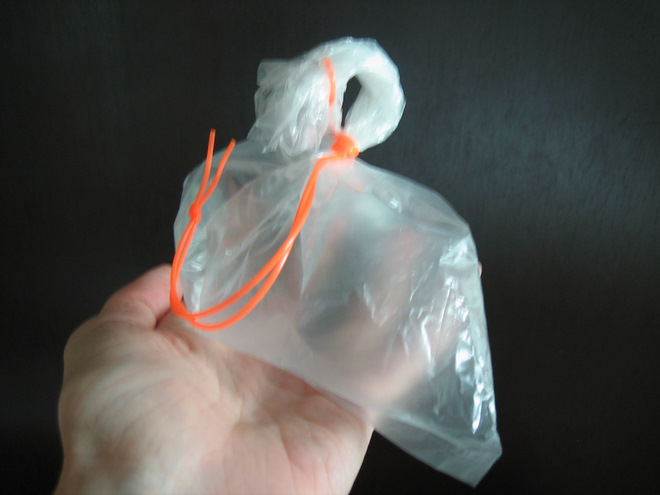
These clever little bags have a drawstring up top (as you can see from this picture of the empty pappadam baggie), which gets cinched and then tied around the base of a loop formed in the bag.


All you have to do is pull on the loop and the drawstring loosens up and you can untie the bag and pour the contents into the serving vessel of your choosing.


How common these carryout bags are remains to be seen, but they're pretty nifty ... unless you're living in a hotel and your only serving vessels are two coffee cups and their saucers.

Wednesday, August 25, 2010

Now that's a cracker!

If you go to the HaitaiTM website you will learn that the Haitai Cheese Cracker is the "Cheese Flavored Legitimate Cracker".

It really is a cracker. No joke.

It's actually a really tasty cracker that could be the lovechild of a CheezitTM and a SaltineTM, but better that either of its "parents". Or maybe that's what the "legitimate" claim is all about. Maybe it's "legitimate" meaning "original" and it's the Haitai Cheese Cracker that gave rise to both Cheezits and Saltines?

In any case, it seems to be very popular with coffee: "You Can Enjoy The light Taste of The legitimate Cracker When You Eat It with coffee" (caps original).

If just coffee and crackers aren't good enough for you though, here are some serving suggestions on the box.

Monday, August 23, 2010

The national pastime

It's kind of a toss-up between shopping and dining.

However, since I'm pretty sure that most of the people I know who have been here for more than three weeks would say it's dining (and that would be nine people out of Singapore's five million residents), I'm going to go with that.

And so begins my first (and still very naïve) post about Singaporean food.

Singapore has plenty of regular restaurants and food shops, but it's most famous for its hawker centers.

Hawker centers are basically open-air food courts with counters offering food from lots of different cuisines. As you walk up to the counter to check out what the stall is selling, the cooks/sellers try hawk their wares. Actually, it can even go a little farther than this and at some hawker centers you may be approached by someone bearing a menu from one of the stands in an attempt to entice you over to their stand to order.

One of our Singaporean colleagues invited the new faculty (and spouses) out for dinner at Makansutra Glutton's Bay. Makan means "food" or "eat" in Malay. So you can sort of think of Makansutra as "How to Eat", but Singapore style.

Glutton's Bay is a sort of a cleaned up mini hawker center. It has really good food stalls that were handpicked by a local food guru named K.F. Seetoh when he re-opened Glutton's Bay a few years ago (the original, in a different location, closed in the 1990s), but it's a good hawker center for beginners because, as our colleague said, it's not as loud or messy as most hawker centers and you can linger over your meal and the food is really good (imperative!). Its smaller size also gives it a nice ambiance and it has a fantastic view of the marina and CBD skyline and the Merlion ... none of which figure into the photos I took that evening. I did take this one of the crazy Noah's ark spaceship casino that opened earlier this summer.


Here's how we ate:

Oyster omelette, which is a fried egg and potato flour mixture that gets nice and crispy (from the potato) but is still soft (from the egg) and topped with small oysters (and cilantro).


Grilled sambal skate with calamansi (the little lime-looking thing that makes really delicious juice) and chili "vinaigrette"


Chicken, beef and lamb (l-r) satay with peanut sauce


Crabrolls


Chili clams and "morning glory" (also called "water spinach")


We ate all of it. And then topped it off with some ais kacang (shave ice) with durian and chendol. It was too dark to take pictures of those, so I'll post photos of another outing for desserts sometime soon.

Food culture is really unbelievable here. It's like a whole nation of foodies. There is food everywhere and there are so many cuisines represented it's astounding. You think you like Chinese food? Well do you like Cantonese? Hakka? Hainanese? Hokkien? Peranakan? Teochew? And that's just some of the more typically local Chinese cuisines, not to mention the varieties of Malay, Indonesian, Indian, and other cuisines I don't even know about yet that constitute Singaporean cuisine.

The cuisine of Singapore is a force to be reckoned with ... a juggernaut to submit to. Ok, so I'm being dramatic (but only a little!) and I don't really mind acquiescing. And since we're waiting for housing and living in the university's executive center with no kitchen of our own, that's a good thing.

More to come ... we've already eaten so much more than this!

Thursday, August 12, 2010

Life as a raised zebra

Don't jaywalk.


This is serious business in Singapore. Here's an excerpt from a 2009 police force media release:

"Pedestrians who jaywalk commit an offence that entails a composition amount of S$20/-. If charged and convicted in court, the pedestrian is liable to a fine not exceeding S$1000/- or to imprisonment for a term not exceeding 3 months. In the case of a second or subsequent offence, the offender faces a fine not exceeding S$2000/- or to imprisonment for a term not exceeding 6 months."

Mind you, the fine in many US cities is considerably higher, it's just that there's no risk of prison time. But does anyone really get put in prison for jaywalking here? I kind of doubt it. However, there's some good signage, and that's the real reason for the post.

The pedestrian is instructed to use the crosswalks.


And here, the crosswalks are called "zebra crossings".


As I have just learned, that's the British English terminology. (Note also the spelling of "offense" in the press release.) The "raised" part? Well, that's because these are a crosswalk + a speed bump.

In my experience, most signs that warn drivers about crossings usually make reference to the thing that's going to be doing the crossing. And I guess this one does too, but with conflicting information: is it a man or a raised zebra?

The British traffic lexicon also includes the entries Pelican, Puffin, Toucan and the (elusive? mythical?) Pegasus crossings, but I've yet to see signs for those here.

I have seen plenty of scofflaws jaywalking their way across the street though.

Thursday, August 5, 2010

First impressions

It's eerily clean, orderly, efficient and quiet here.

Those sound like positive things, so why are they disconcerting? Well, they also stand in stark contrast to some of the things we were quite used to before coming here.

So, I love France, and I miss it, and I want to go back like nobody's business but it's also true that spending a couple of years there certainly made me expect a little grit, more than a little noise, some minor chaos -- unless you're at the préfecture in Marseille (then major chaos) -- and long, long waiting times for official business. Of course, after two years there, I can easily see that there are certain advantages that go along with each of those "negative" things (except maybe the noise one ...) and there are plenty of other really great things about France that make me want to go back, but these are some of the aspects of life that you immediately notice are different here. And that feels both nice, and a little weird.

We stepped out of the plane, which had been full (in coach class at least -- I can't say what was going on up in business or first where passengers get to travel in their own little cocoons because they don't let the riff raff up there) into the calm, cool air of Changi airport and followed the signs through the new and sparkly Terminal 3.

It smelled like the Polynesian hotel in Disney World used to smell in the 1980s. Aahh!

The bathrooms were impeccable and had toilet paper, soap and a choice of paper towels or hand dryers. Yes, this is actually something of note for me and James.

There is a special area of immigration for citizens and permanent residents that allows you to scan your ID card the way you'd scan a subway pass and go right on through. Residents-to-be and visitors have to go to the normal immigration counters, which, in this case, were not so normal because none had a line of more than about eight people and it only took about five minutes including waiting for those eight people in front of you.

James passed through immigration first (it's all orderly and "one-at-a-time", except for parents with small children) and barely had time to get a luggage cart (free) before our bags passed by on the luggage carousel.

Where was this strange land where you could get off a 13-hour international flight, go through immigration and get your bags in less than 20 minutes?

The same strange land where you could get a delicious bubble tea in the airport!


Blueberry and honey.

Or go on a walk on the airport nature trail, or swim in the airport hotel pool.

Also the same strange land where getting your work/resident permit takes about 15 minutes (of your time -- there's obviously stuff that gets done before you get there). We went down to the Ministry of Manpower (which they call "MOM") Employment Pass bureau with our paperwork and photos at the appointed time ... well, actually we were a little early. Luckily, there were greeters to help us.

And that went down something like this:

"What, you're 20 minutes early? No problem, may I have your letter?"
[Takes the letter over to one of the electronic registration kiosks and scans the barcode on the letter, returns the letter to us]
"You can go in and wait for your name to appear on one of the screens. When it does, you may go to any available counter."
We were done before our scheduled appointment.

We did have to get fingerprinted as part of that process (image on the back of the card), or thumbprinted, which seems a little intrusive, but I know that foreigners entering the US have to have all their fingers (and palms) scanned so I probably shouldn't feel weird. It's just that this never happened at the préfecture!

(It turns out my thumbs aren't very printable, so clearly I should have chosen a life of crime ... using only my thumbs. I guess there's still time, but Singapore's strict penalties for lawlessness make this a bad time to get my chops.)

After that we took a little stroll around downtown, got some fresh water chestnut juice and some guava juice at a hawker stand (more on these to come) and were amazed that we were able to carry on a conversation out on the street without having our voices drowned out by passing scooters. It seems people are required to keep the muffler on their two-wheeled motorized vehicles here. And it doesn't hurt that all the roads are new and well surfaced -- though far less charming.

All this calmness was a little too much to take so we went to Carrefour and then sat down for an apéro: the Singapore Sling -- cliché, but a drink I have been curious about since Richard Pryor mentioned it in Superman III.


Some liken it to cough syrup, but I beg to differ. It's a tasty blend of gin, cherry brandy, Cointreau, Bénédictine, grenadine, pineapple juice and bitters. I would get another one, but alcohol is insanely expensive here -- like US$25 for a bottle of certain $7 Trader Joe's wines -- so that will have to wait for a special occasion.

But other than the price of wine, so far so good in clean, orderly, efficient and quiet Singapore.


More pictures to come!

Tuesday, August 3, 2010

Le Mas has moved ...

...to Singapore.

Which means that there are a whole lot of things that I never got around to posting about in France!

I even have a few entries that I started and didn't finish up. Ugh.

Well, I'll have to save those for a rainy day ... some rainy day at some point in the future.

For now, you'll have to read about what's going on nearer to the equator.


Saturday, May 8, 2010

If you want money, don't go to the bank

As I was leaving the bank yesterday, having barely managed to get what I had come for, I thought to myself, money is a strange thing in France (at least from the perspective of someone who didn't grow up here). And I mean that in several ways, but getting it and spending it especially.

So, first, a quick primer: euros come in every denomination you'd expect, and then some. There are coins in the denominations of 1-, 2-, 5-, 10-, 20- and 50-centimes, or cents. There are also 1€ and 2€ coins. Finally, there are bills in the denominations of 5€, 10€, 20€, 50€ (and although I've never seen them in real life), 100€, 200€ and 500€.

That all seems normal, but here's where things start to go awry: when you go to the ATM and get out 50 or more (which you might do most times you go to the ATM for reasons that will become apparent later in this post) you pretty much always get a 50€ bill for at least 50 euros of that. This might make you think that it's easy to break a 50 here. And that's where you would be soooooooorely mistaken.

David Sedaris says it much better in When you are Engulfed in Flames, so I'm not even going to try to be clever here, but basically, you're kind of expected to give exact change and use only small bills and coins. Merchants routinely ask you to use change, "Vous n'avez pas de monnaie?" ("you don't have any change?"), instead of what would seem to be a perfectly reasonable bill, like the last time we rented a car and I wanted to pay for the 17€ insurance using a 20€ note.

Where you're supposed to get these small bills and coins when the ATM routinely gives you 50s is not clear.

And it's not as easy as just using a carte bleu or debit/credit card instead of your large bill. A surprising number (again, I mean surprising to me) of merchants don't take cards. I find this so odd because France has been using the carte à puce or "smart card", since the early 90s and while I haven't been able to verify this, I think France has been using those portable card readers (like you now sometimes see in US restaurants) since then too. But, you frequently need to use cash so you make your large ATM withdrawls, and then you think of ways you can break that 50 ...

Or, there's what's behind door #3: you can write a personal check.

Yes, checks are widely accepted -- almost everywhere you can use cash. Even restaurants (and I'm not talking about ticket restaurant or chèque restaurant, which are a whole different thing) will accept a check from your checkbook.

But even le chèque is not foolproof. For several weeks this fall, I ran paid subjects in an ERP experiment and I am finishing up a second study (the reason I went to the bank yesterday). Basically the way it works is that my supervisor writes me a check and in a roundabout way, I pay subjects with this money.

Roundabout? Yes. For several reasons.

First, you can't cash a check in France, unless you're at your bank and you've written the check. (This is actually probably a good idea because the bank can verify how much money is in your checking account.) So, you can deposit the check that your supervisor gives you and then write a check for cash. Unless you didn't bring your checkbook with you because you were planning on cashing your supervisor's check. In that case, you have to go back to the bank the next day.

But it may not work then either.

There are two branches of my bank in Aix. One of them is open from 9h-12h15 and 13h35 - 18h, the other from 8h45 - 12h30 and 14h - 18h. Despite these opening hours, one has teller service only from 9h - 12h15, and the other one has teller service during its morning opening hours and until 16h45 in the afternoon. Of course these pieces of info are not posted, so when you arrive at 16h55, more than an hour before closing time, that's when you learn that you're out of luck. But, the nice person at the reception tells you that when the teller windows are open, you can get any denominations (coins or bills) that you want. Not that this helps you all that much when you have a subject at 9h the next morning and need to be at the hospital before the bank opens to set up the experiment.

So you go back the next day, after your subject, with your checkbook, during teller hours, ready to get your money. And they're out of it. Or at least they only have one 5€-note. Yes, just one 5€-note. That's it. Not only that, but they were only willing to part with ten euros worth of coins, in a 2€, 1€ and centimes combo.

What gives?

In some ways it's not bad, it's an excuse to buy a chocolat so you can get some change, and undoubtedly, sipping that chocolat will help you think of creative ways of breaking those 20s you had to get so that you can end up with some combination that totals 15€.

Silly me, it looks like I sold the bear's pelt before I had killed it (like that? it's the French equivalent of counting your chickens...). I thought I had all my subjects. And then we realized that we really did have two groups of learners ... and that meant getting more subjects to round out the groups. So yesterday, arriving at the bank only minutes after it had opened, I managed to get only three of the six 5€ bills I wanted. It's ok though, it's the weekend and we're in the middle of a cold snap. A chocolat will taste really good tomorrow.

Thursday, March 18, 2010

Bom chika wah wah ...

It's time for a little food porn.

Chocolate mousse with its crème anglaise and confit de cédrat.


Ok, so this dessert I'm bragging on isn't entirely homemade. Actually, it's mostly store-bought. I'm using the soft lighting and artificial glow that Picasa have provided me to (almost) hide the traces of the plastic mold that this chocolate dessert came in. (Welcome to the Semi-homemade with Sandra Lee episode of Mas de Bonheur!)

What you should really be looking at, though, is what's on top of the purchased chocolate dessert and crème anglaise. That's homemade confit de cédrat, or citron marmalade.

Last year in Grasse, we saw a citron tree, but I had never seen a fully ripe citron, until James brought this one home from the market.


They're all weird and knobby on the outside, and pithy on the inside.


So what to make?

The tarte lady's fiadone seemed like too much of a challenge. And, besides, we also wanted to see what the citron was like on its own. So candied citron it was ... until I cooked it a little longer than I had planned to and it became citron marmalade.

Citron marmalade
1 citron
sugar
water

Juice the citron and set aside what little juice there is for later. The juice is pretty intense. It was a little like *really* acidic grapefruit juice ... or something that's gross and would make you stay away from citrons. (And you shouldn't do that, because the end result is really tasty.)

Using a sharp knife, remove the outside of the peel in long strips. Cut the swaths of peel lengthwise into narrow strips. Try to resist rubbing the zest all over yourself and save it for the marmalade. (It really does smell that good.) You should also resist eating the rind because in its unprepared form, it doesn't taste as good as it smells.

Actually, there isn't much point in giving a recipe here, because there isn't really one to give. It sort of makes itself.

But in case you're actually reading down to the bottom, basically, you make some candied citrus peel, but with a little less water than you might use if you wanted a syrup. I used something like a little teacup full of sugar to two teacups of water (a scant 1/2 c. to scant 1 c.?). Stir the sugar into water over low heat until it dissolves, then add the citron peel and simmer while your dinner finishes baking (20mn?) and then cools enough that you can eat it.

Then add the juice and let it simmer until you're ready for seconds, or until what's in the pot looks like marmalade. Remove from heat.

It smells unbelievable while it's simmering. Just stick your nose over the peel and it's like the best lem-apefr-ange you've ever smelled, with a little something different and special that isn't entirely unlike something that's in molasses.

It's good on bread or brioche, and especially good with chocolate in both its homemade and not-so-homemade incarnations.

Wednesday, March 17, 2010

Mimosas


This lovely (grainy ... sorry!) little pom-pon is all over southern France between late January and early March. This year, thanks to the especially cold and long winter, it peaked in mid-to-late February. Now it's all but gone. Which means that we missed the Route du Mimosa! It also means we won't be able to get any more at the flower market, so it's a good thing James got these when he did.


But it also means that maybe it will actually start getting warm around here soon.

Monday, March 15, 2010

It's Pi(e) day again!

Yes, it is once again pi(e) day and I'm letting myself off the hook with an easy post. Yes, that's right, you guessed it: a food post.

This year, unlike last year, we have an oven. And this means that unlike last year, when we had to have makeshift pie, we can have a real homemade pie.

So apple frangipane it was!


Crust
200 g flour
40g powdered sugar
pinch of salt
100g butter (only a little cooler than room temp if you're doing this by hand)
1 egg, beaten

Whisk the flour, powdered sugar and salt together, then mix in the butter until your mixture looks sandy -- with maybe a few larger blobs of butter. At least this is what happens if you do this by hand because you have no pastry blender or food processor and the two knives cutting technique never worked for you. (And if you're lucky enough to have hands that are like blocks of ice, melting the butter isn't a problem.) Then drizzle the egg over the sandy dough and cut it into the dough with two knives (they do work well for this part).

Chill while you butter your pie pan.

Pour the dough into the pie pan and pat into place. (If you are unlucky enough to have uncharacteristically warm hands during this part of the pie-making, you will end up with a somewhat tougher crust than you'd like to have.) Prick all over with a fork and chill for 30-60mn.

Then bake blind (with rice, beans, weights) for 20mn at about 400F.


Filling
125g almond powder
125g powdered sugar
100g butter, very soft
1 egg, beaten
1 tsp. vanilla extract
2 Tbsp. Amandine (almond liqueur)

Whisk the almond powder and sugar together in a bowl. Add the butter and work it with a spatula until it's well mixed. Add in the egg, vanilla and liqueur, still with the spatula, and mix until it's pretty smooth and homogeneous. Spread into baked shell.


Topping
3 medium pie apples (like Chantecler, a really delicious hybrid of a Golden Delicious and a Reine Grise), sliced thin and tossed with lemon juice. (You will probably have extra, which you can put in a 2010-style 1980s chef salad with ham, Comté and some sort of crazy mesclun mix, instead of iceberg.)

Arrange the apples on top of the frangipane and bake for 30mn at about 400F.

Then eat, from crust to tip.


And make your wish on the last bite.

Almost the ides

Ok, so despite my best intentions, this blog really hasn't existed since I started working full time. And even a little bit before then. I haven't given up, and we haven't stopped doing things, it's just that blogging can take a lot of time. At least for me. But like the dissertation that you put off writing because it's just so big that it's easy to put off, eventually you do it.

Now, however, the question is raised: where do I (re)start?

At the beginning of the things I didn't post about, but for which we have many albums on picasa?

Or maybe the bigger, more interesting things first? If any of it's interesting to anyone.

I'm thinking that reverse chronological order might be the way to go because it's at least seasonal -- in the beginning, but of course less seasonal as you proceed. But then I can mix in new things too.

So anyway ...

Here comes a new post to celebrate an especially special holiday: pi(e) day!

Friday, February 5, 2010

An oven of one's own

There it is.


In this picture, it has a chicken and leek tart baking away in it.


Here, it just told James a really funny joke about the difference between swine flu and bird flu.


Here it's taking a breather after all the cooking it's done in the past month.


So how did we come by this beautiful oven and why hadn't we bought one before?

Well, in the old apartment, there actually wasn't room for one. Ok, so there was technically room for an oven in the apartment -- just not in the kitchen. We had been thinking about buying one for the new place, but then my supervisor beat us to it. If she thinks this will make me work hard for her, she's right. Unless I'm busy making things in the oven.

Le Mas de Bonheur has moved

Well we moved on over, moved on over,
To the ouest side.
To a 1-bedroom apartment on the first floor.
Oh oh we moved on down, moved on down,
To the first floor.
Now we finally got a washing machine of our oooooooowwn!

So as many of you already know, we moved. Back in mid-November.

It's been a busy time. Ahem.

Our new apartment, as the theme song homage (if you were able to stretch and shorten those syllables in new and creative ways) suggests, is on the west side of town. It's about a 10mn walk from the old place, which means I can't step out of our apartment and go to the market (or to the Cave), but it's better.

For one thing, it has a separate bedroom ... with a door ... and a condemned fireplace in marble (on the right in the foreground).


It also has a washing machine (on the right, next to the tiny, more typically-sized refrigerator), which also serves as a drying rack for the dishes.


And a nice breakfast table.


It has an attractive living room ... which you will see a picture of sometime soon.

With a really cool bird relief that is where the chandelier used to be when the living room and bedroom were just one large room.


It has a gigantic terrace. Which isn't quite as scenic as the old one, but it'll do.

Oh, and one of the best things is that it also now has an oven!

Monday, January 11, 2010

Mirabelles in winter

In the dead of winter, when it's colder here than it's ever been ("ever" since we arrived in September, 2008), it's nice to think of warmer, sunnier times.

And since the last post (months ago ... this is what happens when you get a full-time job) was about mirabelles, here's a one about mirabelles in winter: clafoutis aux mirabelles ... surgelées ("frozen").


Clafoutis comes from Limousin (also famous for its cows, and Limoges porcelaine) and is traditionally made with unpitted cherries. In fact, if you make it with another fruit it's not technically a clafoutis but une flognarde.

The recipe I used was for a traditional clafoutis with fresh (not frozen) sweet cherries and it strongly advised against pitting those cherries because, it seems, it's the pits that give the clafoutis its distinctive aroma. I've actually never had a clafoutis that didn't have pitted cherries in it, so I can't say whether or not the claim is true. And I couldn't find any frozen unpitted cherries, so I figured I'd wait until cherry season to try it the traditional way.


Recipe (adapted from Cuisine et Vins de France)
1lb. frozen pitted mirabelles, thawed
scant 1/2 c. sugar + more to dust baking dish
4 eggs
scant 2/3 c. flour
scant 1/2 c. cream
1 1/2 c. milk
1 Tbsp. amandine liqueur (amaretto?)
butter
powdered sugar for dusting (if you have it)

Preheat the oven to 400 (wait, "what oven do you guys have?" you ask ... well, that's for another post). Whisk the eggs with the sugar until frothy. Add the flour, little-by-little, whisking constantly. Then add the cream and milk in a stream, still whisking constantly. Finally, add the liqueur.

Generously butter a ceramic baking dish (this is what the recipe says ... nothing about size ... mine is about 11 in. across and 1 1/2 in. high, and there was actually too much batter, but then I had extra large eggs) and dust the bottom and sides with sugar.

Arrange the mirabelle halves in the bottom of the dish and gently pour the batter over them so as not to displace the fruit. Bake in the oven for 30 to 35 minutes, until the clafoutis is golden. Dust with powdered sugar and serve hot or warm.

Wednesday, October 7, 2009

Mirabelles

A mirabelle is a delicious little plum that is about the size of a quarter in diameter. Sometimes, although these don't, they have a red blush.


Lorraine is the region of France best known for its mirabelles, especially the cities of Metz and Nancy, which both have their own varietals ... and festivals celebrating the mirabelle (Metz even has a Miss Mirabelle!). In fact, the "Mirabelle of Lorraine" has something called an Indication Géographique Protégée which says that only mirabelles grown in a specified list of cities, towns and villages can be called Mirabelles of Lorraine (kind of like the AOC label on wine, but with seemingly fewer restrictions). The list of towns in the "appelation" is determined by, among other factors, historical references dating from the 16th century about the place of the mirabelle in literature and in texts on local gastronomy.

They ripen in August and are still quite tasty in early September, although I haven't seen any in the markets for a couple of weeks now. They are extremely flavorful. Put that colander of mirabelles on the table next to you and you will smell apple-vanilla-plummy goodness without even sticking your nose down next to the fruit. They're unbelievable.

The one area where they don't excel, at least not the ones we have tried, is in texture: they're often a little mealy (for me). But you don't notice that at all when they're made into the jam. I guess technically what James made is a compote because it's just cooked down mirabelles, lemon juice and a little sugar, but we eat it like jam. And by "like jam" I mean out of the reused Bonne Maman jar, by the heaping spoonful.

Or you can do things the more traditional way and eat it on bread.

Tuesday, October 6, 2009

Serving suggestions

There has always been a special place in my heart for the "serving suggestion" caption on food packaging. I mean, how else would I have known that I could eat my cereal with milk?

In France, the serving suggestion is taken to a whole 'nother level.

Here's one idée repas équilibré, or "an idea for a balanced meal", taken from a carton of gazpacho (yes, we buy it ... we don't have a blender):


Don't even think about having that meal with plain gouda instead of gouda with cumin, or with a baguette instead of bran bread!


Here's the way you might consider eating your blueberry yogurt:


Thanks, blueberry yogurt! I never would have thought of that!

And for the 6-10-year-old children who eat my Nutella, here's an idea for un goûter équilibré, or "a balanced afternoon snack", after a full day: a slice of bread with Nutella, a plain yogurt and a glass of orange juice.


But how much Nutella? How much orange juice? Not to worry, the fine print perpendicular to the rest of the label tells you that it's 30g of bread, 15g of Nutella, 125g of yogurt and 100ml of orange juice. Voilà!

I make fun, but this is a country whose ads for just about everything consumable (especially snacky things) include the phrases "for your health, avoid snacking/eating between meals" or "for your health, get some physical activity" or "for your health, eat at least five servings of fruits and vegetables per day".

And besides, gazpacho really is a fresh and tasty way to eat my vegetables!

Tuesday, September 29, 2009

First anniversary

Actually, we got to Marseille a year and eleven days ago, and we hadn't even found our current apartment a year ago at this time. And the not-so-prompt beginnings of the blog? Well that was just under 10 months ago, but who's counting?

The point is, by some measure, we've been here for a year. So to celebrate our first anniversary in France, we went to Spain!


James had a conference in Barcelona, so I met him there and we stayed a couple of extra days. Museums, beautiful buildings, sites, food (thanks to Ann and Dalen for their recs!), music. It was great!

I took the bus for a cool 60€ round-trip. So what if it took more than eight hours to make what Google calls a 4h33mn drive? It was cheaper than driving and, overall, pretty pleasant.

I had been a little worried about the notification on my ticket that for the comfort of other passengers there would be no eating aboard but, clearly, eating was allowed ...


So I did not feel guilty eating the sandwich I had made, over the bag I had brought it in.

I had not been worried about the other half of the notification on my ticket that there would be no smoking on board. Like the proscription on eating, though, the rule was not strictly enforced. There was smoking on board, but only by the driver and only with his window open. He also sang along in something like harmony with the chorus of Cher's Believe. Not an easy feat when you think about the synthesized vocals in that song. He deserved a cigarette or two.

And at the end of it all an ultra-stylish, but budget hotel was waiting for me.


Day 1 (for me ... James was still conferencing)
Montjuïc
At the base of Monjuïc is the Plaça d'Espanya, which marks the entrance to the pavilions of the International Exhibition of 1929. Right on the Plaça is the Arena de Barcelona, built in 1900 in the Moorish style.


It used to be a bullfighting ring, but is now being turned into a shopping center with the help of that big crane.

Here's a view up the hill to the Palau Nacional, built for the International Exhibition.


The Palau Nacional now houses the Museu Nacional d'Art de Catalunya (MNAC), which is a huge collection of the art from Catalunya from the 11th century to mid-20th century. The coolest part, even though it's generally not one of my favorite periods for art, was the Romanesque collection (11th - 13th centuries). From this link, you can see samples of art from these rooms, but what you'll see doesn't do it justice.

Basically, back in the early 1920s it became apparent that a great deal of art from the Romanesque churches of the region was being sold to foreign collectors. In order to keep the art in Spain, The Board of Museums had it removed from the churches and reconstructed it elsewhere. To do that, the paintings (or what remained of them after 700 years) were cleaned, then covered with lime casein (which seems to be some kind of natural paint?), and then fabric. Apparently this allows the painting (or by a related technique the painting and some of the plaster behind it) to be stuck to the fabric and pulled off the wall. It can then be reattached to a new wall in a different place, which is what you can see at the MNAC.

So as you walk through this section of the museum, they have it set up so that it's like you're walking through these Romanesque churches.

It was cool.

On the way up to the Palau Nacional, you walk by the Metalurgy Pavillion, which has this really cool facade.


You will also walk past the extremely beautiful Mies van der Rohe pavilion.


The original was the German pavilion for the 1929 Exhibition and, following tradition, was torn down after the Exhibition ended. It was rebuilt in the mid-80s.

Here's a view back at the Plaça d'Espanya, most of the tourists cropped from the photo.


Here's another view from the Palau toward Gaudí's Sagrada Familia in the center-left of the picture (which, I'm sad to say, looks like a dying spider with its legs in the air in this picture) and the Torre Agbar, by Jean Nouvel, on the right (the shiny, blue-gray torpedo-shaped tower). The Torre Agbar was supposed to reflect the shapes Gaudí used and at the same time echo the form of the mountains at nearby Montserrat.


On my way home, I stopped by Barcelona's Arc de Triomf, built in the Moorish style for the 1888 Universal Exhibition.


And here's James looking out the back of our room onto the terrace and up at the rooftop of the Pedrera.


Then it was time for dinner. Or almost.

As it turned out Cal Boter, an old-school Catalan place off the beaten track, didn't open for dinner until 9pm. So when we got there at 20h45, we gave our names and went to get an apéro at a nearby bar.

At 9:15 we went back and they were ready for us.


Seared foie gras with roasted peppers and eggplant on a Catalan style flatbread in the foreground and mushrooms stuffed with a salt cod-potato-garlic mixture. Yum!

Filet with porcini mushrooms (not the most attractive of presentations, but mushroomy and beefy and very tender).


Cabrito with roasted potatoes. It was delicious -- even I thought so and I tend not to be fond of the goat.


All accompanied by a Rioja, which we hadn't had for ages, and finished with a coffee. (It just felt a little late to start dessert at 11:30 ... but not for a coffee, if that makes any sense at all.)


Day 2
After a leisurely morning and brunch, we walked along the Port Vell (the old port) over to the Ramblas and wandered up the Ramblas and through the Barri Gotíc. Of course we had to stop at the Mercat de la Boqueria.


Where we got delicious fruit juices: guanabana and dragon fruit.


We went to the Cathedral, Saint Eulalia, which is mostly covered in scaffolding making for a poor picture. However, you can take an elevator up to the roof and walk around on some of that scaffolding.

In Parc Güell we decided to play "Where's Waldolisa?". You probably will find me because as I look at this picture it sort of seems like a good portion of the thousands of other tourists who were at the park cleared out of the frame right at the moment James snapped his picture.


There were so many people there you couldn't really take any pictures of most of the structures without having 100 strangers in the photo. (Seriously, try counting the number of little heads in that photo -- 100 easy!) Besides, those are things you've probably all seen or seen pictures of before. Here are a couple of pictures James took of items less photographed.


The chain links in this gate were soft, not rigid:


After all that sightseeing, and French-speaking (we ran into some tourists who needed help) we needed a snack.

Tapas at Tapaç24. It's a low-key, basement tapas bar owned by a celebrity chef with a much pricier and more famous restaurant to his name. The tapas were very tasty, but the service was extremely poor.


"Bikini" with serrano, mozzarella and truffles.


Croquetes of jamón ibérico.


We also ordered some fried anchovies. However, these never came. And our waiter didn't bother to tell us that they were out until we asked for our check and he noticed that he'd never brought them. Sigh.

Dinner that night was at Ann's recommendation, somoRRostro. The food was fabulous, the restaurant was very attractive and the staff were extremely friendly and poured water and replaced silverware with a flourish. If only I had video.

I do have some more no-flash photos of our food though.

Purple potatoes with marinated mackerel and parmesan mayo.


The 'mayo' was just a smear on the left side of the plate (under the fennel).

Sautéed sepia with toasted rice sprinkles.


"Hake" (and by that I mean monkfish because they ran out of hake) with shitakes, asparagus and sweet garlic.


Monkfish three ways: potatoes, sizzled jamón ibérico and kale.


Chocolate cake (very good) with its foam (an unfortunate mint chocolate) and mango ice cream.


Financier with seasonal fruits and a sweet wine sauce. Also, those little white cubes are marshmallows.


Mmmmmmm ...


Day 3
One thing that was really remarkable about Barcelona was the number of tourists. Now, it's not so surprising that there would be tourists at tourist sights, but the sheer number of tourists, nearly everywhere, was astounding. We were tourists, and it still felt like there were tons of tourists there.

This is a picture of Casa Batlló, and there are about 50 people standing outside in line to get it. It's already open.


We went back to Montjuïc and walked around the outside of the Palau, through the Olympic park and then went to the Miró museum (no photos allowed).

We enjoyed the gardens behind the ethnological museum. As did these other tourists who decided to hang out for a while discussing the ins and outs of lily pads.


We went in the Pedrera, but couldn't go on the roof because of rain. So no close-ups of those chimneys over James' head in that picture out of our hotel.

Since it was not quite 9:00 and too early for dinner, we decided to go to a classical guitar concert in the Basilica Santa Maria del Pí.


And then it was time for dinner.

On a Sunday night at 10:30pm, pretty much nothing is open in Aix. Not so in Barcelona. Things are still hopping.

Fried anchovies.


Pulpo a la plancha with patatas bravas.


But wait, there's more!

As if two people could eat any more (I didn't even include everything -- did I mention that I think we gained weight in Barcelona?), there was still Monday morning before James' flight and my bus. The highlight was another juice drink (and the manchego and serrano we bought for later!).

Blackberry and guava-coconut-vanilla.


So here's to another year!